Language Learning and Linguistics
Years of schooling, life experience in China, and a Chinese marriage have given me a fairly strong command of the Chinese language, which really helped integrate into the society while I was there. Despite my interest, I’ve never approached conversational fluency in a third language. With my educational background in linguistics, my language studies have left me knowing more about languages than how to communicate with them.
Linguistics is the scientific study of language. People have a misconception that linguists learn languages, but they don’t necessarily know how to speak the languages that they study. Linguists are more interested in how the language works. However, the two groups aren’t mutually exclusive; knowing about how a language works can be very helpful in learning it quickly, and you can also learn a language to a high level without knowing much about the grammar (though it would be more difficult). I fall into both groups.
I love the idea of learning a foreign language to a conversational level, but it requires time, planning, and access to appropriate resources. I initially studied my third language, Japanese, so I could communicate basic needs while I was there, and I reached my goal. However, I’m not organized enough to go beyond that.
Even if I lack the commitment to go further in my language studies, I still love the technical and logical challenges that language study presents. Grammar for me is fun. A good time. It was true even in school as a kid, when we learned to draw Reed-Kellogg sentence diagrams.
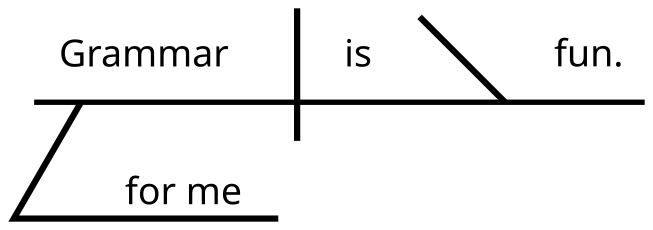
Do they even still teach this in grade school?
Grammar puzzles are wonderful, and many languages, including English, have interesting quirks in their morphology and syntax. If you studied English in school, for example, you might know that English word order is generally Subject-Verb-Object (SVO). You’d also know that English verbs have to “agree” with their subjects: I have a guitar, she has mad skills. Both English word order and agreement seem to break down in certain constructions, notably with There + be sentences, where the verb seems to agree with its object: There is a way, there are strategies.
And then regional variations change the rules, too. In British English, collective nouns like committee or team are treated as plural. The English language learning website English Club has a note about American writers of English on their page about collective nouns:
Some writers of American English treat collective nouns as singular at all times.
Yes. Yes, we do. But not always. Popular magazine Rolling Stone uses the plural to refer to group names, like this recently published article, “Cola Make Modern Alienation Sound Radically Original on ‘Cost of Living Adjustment’.” By contrast, Billboard Magazine seems to stick with the singular, as in this heading in an article about Barcelona’s recent Primavera Sound music festival: “The Cure Lifts the Clouds With Uncharacteristically Poppy Headlining Set”
Each language brings its own set of grammatical quirks. Japanese and Korean have SOV word order and nuanced systems for marking grammatical function. Mandarin Chinese uses no plural markings for most nouns, and while it’s ostensibly also an SVO language like English, it employs a topic-comment grammatical structure that often flouts English speakers’ expectations on word order. And that’s just in the languages I’ve studied; other languages have even more exciting ways to use grammar.
I also love learning about and practicing pronunciation. English has about 24 consonants and around 20 different vowels. It allows for consonant clusters with as many as five consonants, for example in the word angsts [æŋksts]. Mandarin Chinese has a much smaller phonemic inventory but four distinct tones that differentiate words. Many of the sounds of Mandarin don’t exist in English.
The tones are the most challenging aspect of Chinese pronunciation because they are critical to conveying the intended meaning. Japanese pronunciation is overall easier to learn than Chinese, but it also has pitch accent and a moraic timing system. (Swedish is another language that has pitch accent, apparently!)
Aside from learning about grammar and pronunciation, I also enjoy learning the lexical relationships between languages. As much as one third of the modern English vocabulary was borrowed from French, for example. As a language learner, I love finding cognates. This happens a lot in Romance languages like Portuguese for words like possível (possible). But it also happens in unrelated languages like Chinese. 秀 [xiù] means “show” as in “talk show.” 脱口秀 [tuō kǒu xiù] sounds like “talk show” but is closer in meaning to “stand-up comedy.” 幽默 [yōumò] comes from the English word “humor” but is used as an adjective describing someone’s personality. Many other examples can be found on Wikipedia.
Japanese, having a long history of contact with Chinese, also has many loanwords and a writing system derived from Chinese. Because many words were borrowed into Japanese from earlier Chinese, they also offer a window into historical Chinese pronunciation. For example, 会社 kaisha is Japanese for “company,” and it retains the [k] sound at the beginning of the first character, which has debuccalized in modern Chinese from kuaì to huì. (Chinese retains the [k] sound in one modern word, 会计 [kuaìji, “accountant”].)
I’ve got a lot of random bits of information about languages floating around in my head. While learning a third language to a conversational level remains elusive, my language learning efforts haven’t been in vain. I think that learning a language is a good way to show respect as a tourist and is practical for countries where fluent English speakers are uncommon, as is the case in East Asian countries like China and Japan. What more reason do I need to learn about how languages work other than the fact that I enjoy it? Some people like to do crosswords or read novels. I like to learn about grammar. Even if my language studies don’t ever go beyond that, I’d say it’s still a worthwhile pastime.