What Happens During Chinese New Year?
Contents
Today marks the day many people go back to work in China after the Spring Festival holiday. Having experienced nearly a decade’s worth of them, now is a great time to introduce this special holiday and reflect on its significance.
Duration and timing
Chinese New Year is celebrated as Spring Festival, a week-long holiday in the first week of the lunar new year. The Chinese government officially observes the holiday on the first three days, and uses a comp day system to extend the holiday to one week. In practice, this means that the week-long holiday is book-ended by two six-day work weeks. Each year, the government publishes the official holiday calendar so you can plan your recuperation from the first six-day work week, only to do it again once you’ve rested up.
Despite the brutal work schedules, people look forward to Spring Festival. It’s often the only time during the year that the whole family can get together, so it’s an important moment. It’s no wonder that this time of year is home to the greatest annual human migration in the world, called 春运 (chūnyùn, “Spring movement” or “travel rush”).
Activities before the new year
So what do people actually do during Spring Festival? I can only speak with any certainty about traditions in Northeast China, but there are many commonalities between regions.
Preparation for the festival begins with decoration. Two must-have items are a couplet (对联 duìlián) and a 福 (fú) character, both typically printed or handwritten in calligraphy on red paper. The couplet is hung on either side of the entrance to the home, with a shorter phrase to finish the couplet above the door. Then the fú is pasted on the center of the door, often upside down.
Why upside down? Mandarin Chinese has a small phonemic inventory, making puns seem nearly inevitable. And an upside-down fú is a perfect example: 福倒了 and 福到了 (fú dào le), which mean either “The fú is upside down” or “Good fortune has arrived.”
Chinese is full of these sorts of things. 年年有余 (nián nián yǒu yú), a common New Year’s phrase that translates to “abundance every year,” is one reason why New Year’s dinners feature fish: the phrase sounds exactly the same as “fish every year.”
Spring cleaning is another important activity that precedes the new year. Families will dust and clean their homes in a symbolic gesture to clean out the bad luck of the previous year, making room for new bad luck—ahem, good luck—in the new year.
During the new year
When family arrives from across the country or across town, food is one of the main attractions. Families will prepare a large late lunch on New Year’s Eve, often making as many as eight or more dishes. This meal, at least in my wife’s family, is reserved for immediate family and is ready by 1:30 or 2:00 PM.
After the meal, everyone rests for a while. Dumplings are for dinner. In my wife’s family, they start making the dumplings around 9:30 or 10:00 PM, often while watching the New Year’s Gala that the central television station puts on every year.
Scaring away the monster
As the sun sets, and often before, the neighborhood gets punctured by the sound of explosions as fireworks go off. Nobody whose ears still work will be sleeping early this night. The story goes that there was a monster by the name of 年 (nián, “Year”) who came around once a year to terrorize a village. Nian wasn’t afraid of anything, except—apparently—loud noises and bright lights. So, the people made fireworks to scare him away, a tradition which continues to this day.
It must be working. I’ve never seen a monster trundling about and eating people.
Chinese people take their fireworks seriously.
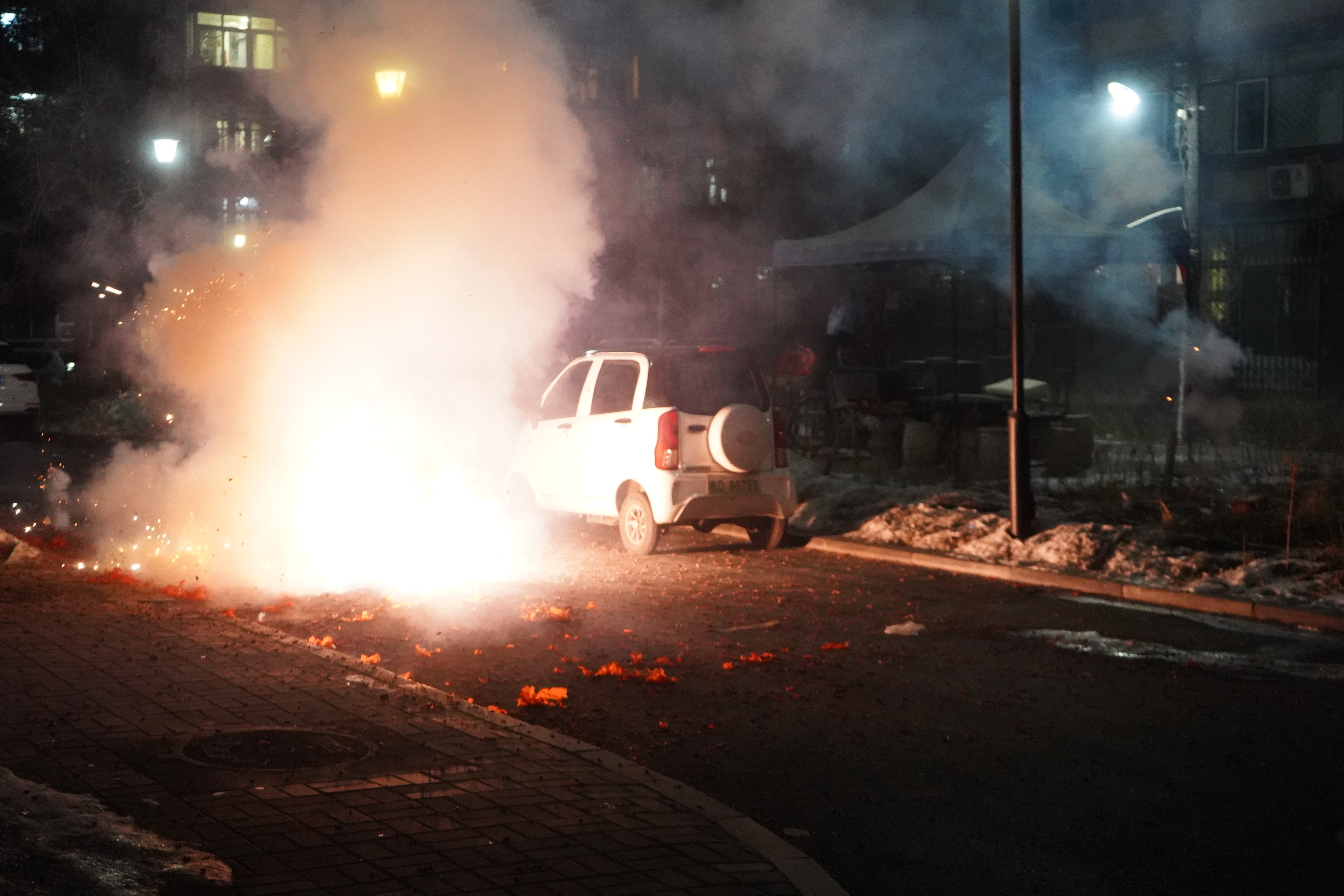
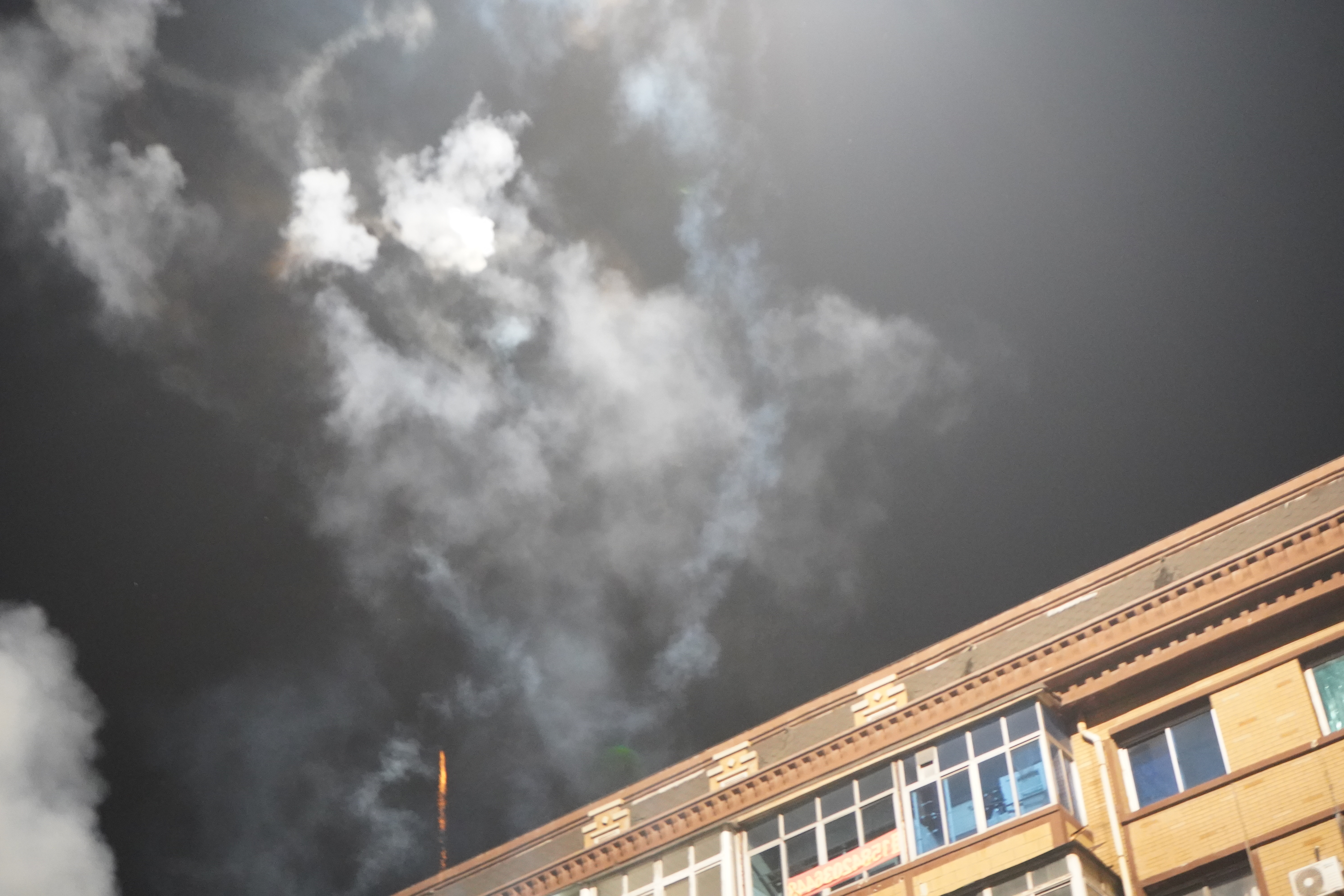
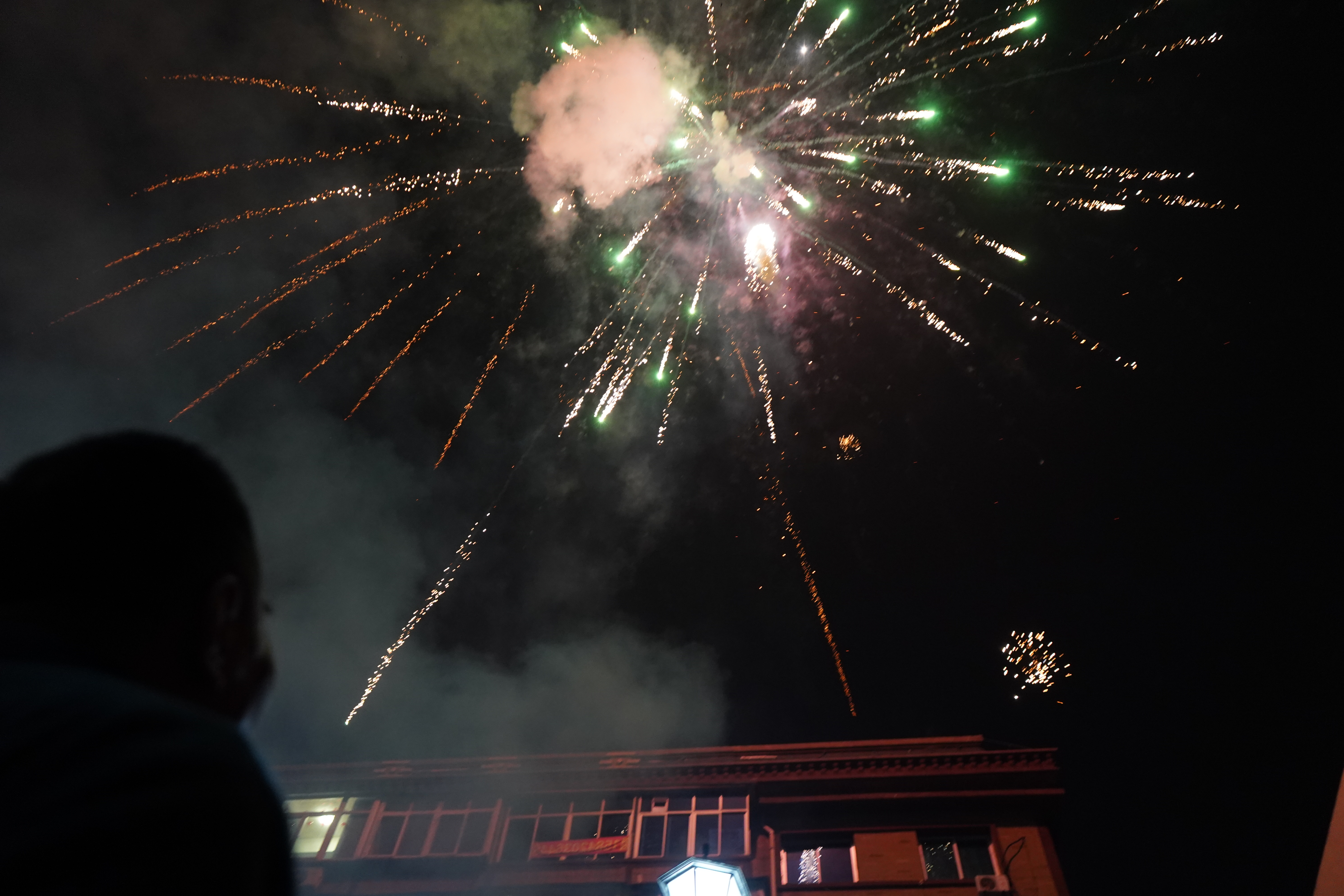


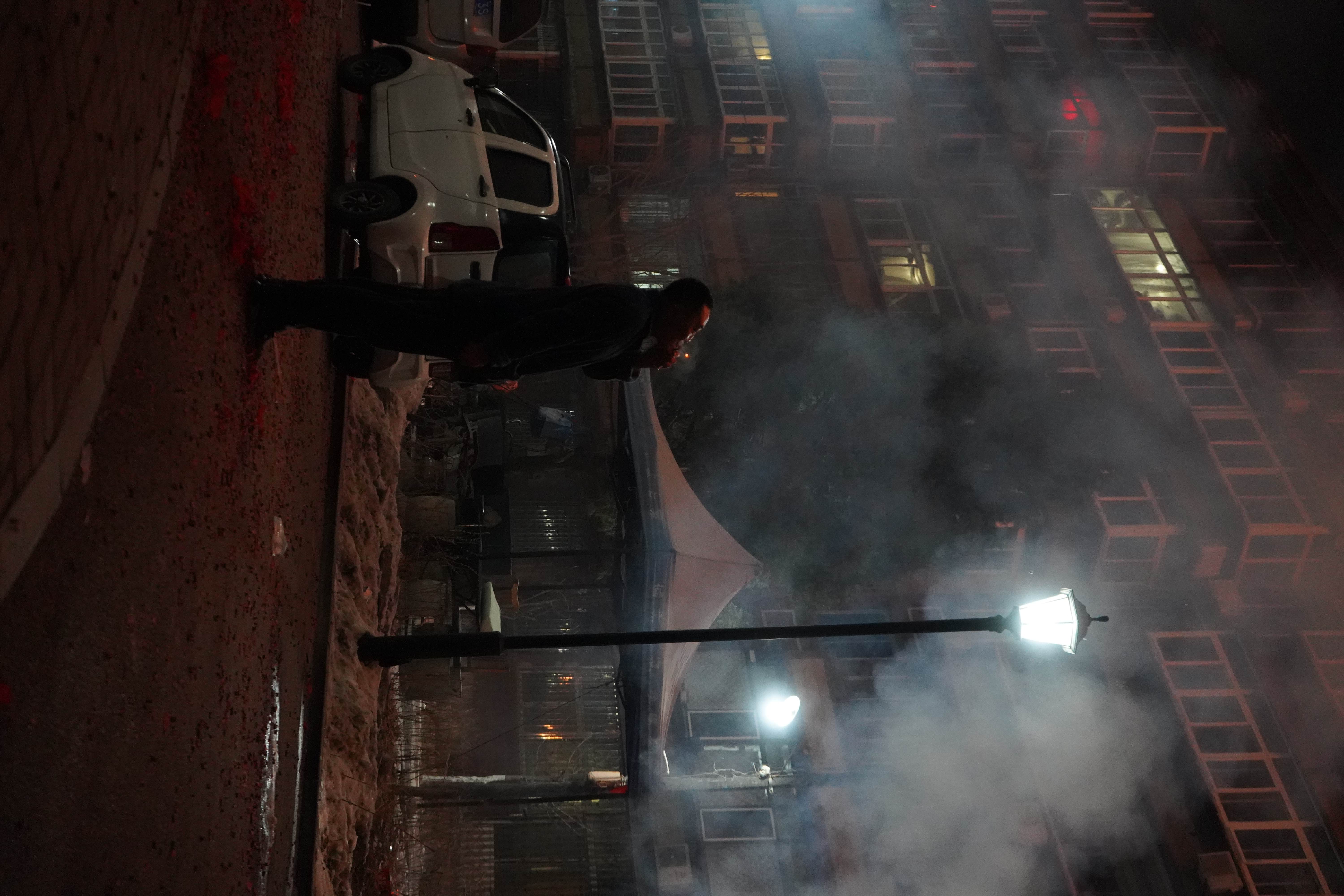
Fireworks at the Chinese New Year’s Eve celebration
Really seriously.
Even in Beijing, where it’s illegal to set off fireworks, people still light them. The night skies of the suburban districts on the edge of the city are filled with flowering sparks of red, gold, and white. The video above represents a typical Spring Festival scene, with local residents gathering together to put on a fireworks show.
In my wife’s hometown, neighbors light fireworks even more enthusiastically.
A uniquely Chinese holiday
The only thing that might come close to what Spring Festival feels like would be a cross between Thanksgiving and Christmas. During Spring Festival, nearly everyone in the country has time off work for a whole week, a rare opportunity for people to get together with family. Unlike Christmas, Spring Festival has no strong religious connotation (although Christmas’s religious tone is certainly debatable in the US).
People spend days at home with family, eating nuts and little candies, dumplings, and more dumplings. During one of my first Spring Festivals, I ate raw pecans for the first time. I had no idea what they were, but they were deliciously sweet and looked kind of like walnuts. It took me a year or more before I figured out why 碧根果 (bìgēn guǒ “pecan nut”) sounded so familiar to my ears.
Alcohol is also consumed during large family dinners. I have had the glorious misfortune of enjoying the national hard liquor of China, 白酒 (báijiŭ, “white/clear liquor”). It’s distilled from sorghum, a type of coarse grain, and it will leave a strong impression on you. If you haven’t tried it, you’re missing out on a revelatory life experience. I’ve been there, done that, though, so I’ll stick to bourbon or rye, thank you.
There’s a special feeling in the air during Spring Festival. The sights, the sounds, the smells—it’s something uniquely Chinese, and really quite charming. The feeling is even stronger in places away from the stricter air pollution regulations of the major cities like Beijing and Shanghai. The explosions of firecrackers continue uninterrupted across the city for the entire week.
Looking back on it, it’s one of my more special experiences during my time in China. There’s something about eating together around a big round table, sharing family-style dishes together. It’s enough to make the typical American uncomfortable, but I like it.
I think of the careful seating arrangement to account for my left-handedness so that I don’t “fight” with the person next to me when reaching for food.
I think of learning how to prepare the dough for steamed dumplings, rolling it into little disks, loading them with (too much) filling, and pinching them into a crescent moon.
I think of awakening to the sound of firecrackers before eight in the morning on the street below the eighth floor room of a hotel in a Northeastern town. It was New Year’s Day, 2018, my first time experiencing the holiday. The sun was just peeking through the haze over the buildings on the horizon.
These memories are just a few examples of the significance of living abroad. They have given me a small glimpse of what it means to be Chinese, something that few Americans understand. They are also fond memories of the second home I made for myself in China. Added together, they form a complex, significant part of my identity as a world traveler and a man between cultures. I wouldn’t give it up for anything.